The Coop, Episode No. 17
Les Fleurs de Mai
This month we’re enjoying the last fruits of Spring before the long Summer sets in completely. After a busy month of festivals and parties, May is a great month to take a step back, find a cool breeze to sit in, and let it all soak in. Walks in gardens, getting out in nature, reflecting on the life of one of our greatest friends and influences that we lost this month, and exploring some new music seem to be the perfect activities to suit the mood. As Summer draws closer and the air starts to get thicker, we’re also taking the moment to think about the Coop and how we may be able to better suit the tastes and interests of all our amazing subscribers. We’re working on a total revamp of the platform this month that we think you’re all going to love. We can’t wait to share the new concept with you next month!
ALLONS à LOUISIANE:
60 Years of Arhoolie in Louisiana
a special jazz fest 2023 exhibit
From the earliest days of Arhoolie Records, founder Chris Strachwitz was drawn to Louisiana and its music. From the traditional jazz of New Orleans to the distinctive Cajun, Creole, and Zydeco sounds of Southwest Louisiana, Strachwitz recorded scores of albums showcasing the musical wealth of the state. Over six decades, he also carried his camera and captured the diverse artists, traditions, and places that defined Louisiana music. This year at Jazz Fest, Arhoolie Records collaborated on a special exhibit displaying some of his amazing photos and taking festival go-ers on a journey through Chris’ eyes of Jazz Fest over the years.
Born in Germany in 1931, Strachwitz immigrated to America with his family in 1945. He became fascinated by the blues and jazz he heard on the radio. After college and his discharge from the Army in 1956, Strachwitz took a bus trip to New Orleans — his “city of dreams”— to hear the music he loved firsthand. Strachwitz was at the first Jazz Fest, introducing Arhoolie recording artist Clifton Chenier. Over the years, Strachwitz photographed the festival as it grew into a major musical and cultural event, providing a vivid history of the festival, the organizers, musicians, and concertgoers.
Strachwitz worked tirelessly his entire life to share the sounds of New Orleans and Acadiana with the world. The exhibit, ‘Allons à Louisiane’ represents only a fraction of Strachwitz’s 25,000 photographs. The Arhoolie Foundation preserves this collection, and a selection of Strachwitz’s photographs, Down Home Music, will be published by Chronicle Books in autumn 2023.
in loving memory, Chris strachwitz (1931-2023)
As fate would have it, the beloved Arhoolie founder Chris Strachwitz passed away peacefully at the age of 92 in California on May 5th, 2023, during Jazz Fest and while this exhibit was on display. Chris’ impact on Louisiana music and music everywhere will never be forgotten and will be felt for generations to come.
JARDIN FROZARD
reviving louisiana traditions through native farming
Half an hour north of Lafayette, just outside of Arnaudville and tucked away on an oak tree covered road, lays a small piece of land with some unassuming signs in French. Jardin Communautaire Frozard, is the community garden and ongoing project of Johnathan Olivier. Olivier grew up in here in Louisiana, learning French from his parents and grand parents and hearing stories of the old ways of living with the land here in our very specific environment. In 2019, Olivier found a piece of land with the idea of revitalizing those old ways and creating a space for language preservation, and started Le Potager d’Acadiana, a bilingual bio-intensive market garden (Le Potager d’Acadiana) that provided fresh vegetables for the community. Throughout the pandemic, Olivier pivoted his vision to become a more inclusive, laid back community garden, where folks can come to learn about organic farming in a bilingual context. These days his focus is growing brown cotton and native / medicinal plants, while studying to be a ‘traiteur’ (a French / Cajun / Creole faith healer).
johnathan’s mangolier tea recipe
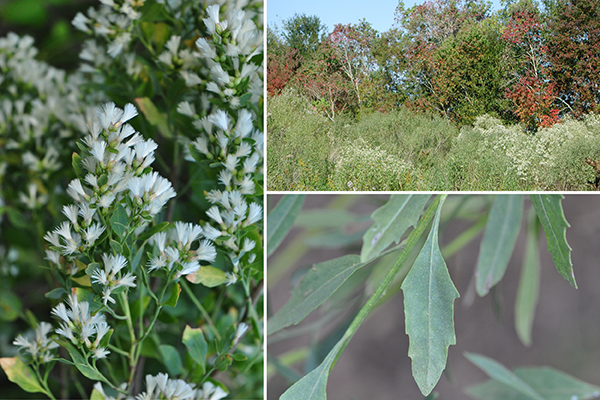
The groundsel bush (Baccharis halimifolia) is more commonly known in Louisiana as “manglier.” Found all across Louisiana, the plant has been used for years as medicine by Indigenous peoples and, later, traiteurs in the Creole and Cajun communities. Typically, folks used manglier leaves in a tea to treat a variety of ailments like fever, colds and respiratory issues. Recent research has shown that manglier leaves indeed contain anti-inflammatory properties. Due to manglier’s bitter taste, people usually added lemon, honey, or even a bit of whiskey to enhance the flavor. This is my go-to manglier tea recipe for when I’m feeling ill or if I just want an immune system boost.
Ingredients:
- Fresh manglier leaves (dry work too)
- Oat straw
- Fresh ginger
- Green tea
- Lemon
- Honey (optional)
Directions:
Grate fresh ginger, about a table spoon. In a pot, add water and ginger, and then manglier leaves and oat straw at a 1:1 ratio. Cover and bring to a simmer for 10 minutes. Pour the tea through a strainer into a cup, then add a green tea bag, allowing it to steep for five minutes. Squeeze a quarter of a lemon into the tea, then add a bit of honey if desired.
LEAH GRAEFF
“Little things”
With so much Cajun and Creole music around every corner here in Acadiana, we often forget that there is a treasure trove of talent here of ALL genres. Here at the Coop one of our missions is to share all different aspects of the musical culture we are so lucky to have here, and Leah Graeff is a perfect example. Leah was born and raised here in Acadiana, and her debut album has been years in the making. Owner of the Janin House (as featured in our FIRST episode!) and frequent collaborator of artists like K.C. Jones (check out the background harmonies on K.C. recent solo album), Leah’s music takes us decidedly far away from a Cajun sound while still staying rooted in place and tradition.
Leah Graeff’s songs are nursery rhymes of the definitely wise variety, as breezy melodies mix with brooding lyrics to offer winking lessons on life and love. Graeff’s songs are a sweet, and lulling steady look at the kind of emotional rollercoaster every listener living a full life can recognize. The long awaited “Little Things” debuted this month, was recorded in Lafayette with Allison Bohl DeHart, Peter DeHart, and Chad Viator.
ÉCOUTEZ!
By Ann Savoy
Long ago I used to go to the library at LSUE to look at the Louisiana section of books. I also loved browsing through old copies of Century Magazines, that were published starting in 1881, and Schribner’s magazines, 1897. Back when I would visit the library these old documents were accessible to the public, and even Sieur Du Pratz early exploration journals were in the library to hold and wonder at. The odd little illustrations in the Du Pratz books were pretty thrilling- pen and ink sketches of Melon ‘d’eau, the way the Attakapas natives dressed, cocodries…on and on..the books were little leather bound tomes with gold stamped titles.
Century and Scribner’s Magazines used to publish many articles on, for example, Travels to Acadia, Louisiana Swamp People, A Voyage to Louisiana. These articles were illustrated with etchings of early lives on the bayous. One such article was called Creole Slave Songs. New Orleans had a wealth of songs in Creole French, melodically and poetically totally different from Acadian music but another window into this fascinating state back in the1800’s.
There was a poem in the Creole Slave Songs article that had such beautiful vocabulary and such a touching story that Jane Vidrine and I decided to put that poem to an old creole melody. We recorded this song on both Todd Mouton’s Je M’Endors lullaby CD and on our lullaby CD/booklet for Valcour Records, Fais Do Do: Louisiana Lullabies.
As you will see, the lyrics are in Creole French, and the story is about how the little Creole orphans survived out in the swamps. They were smart and industrious little children, and gathered delicate berries to sell in the market, fished the bayou for perch, trapped birds with their cages, made ink from pokeberry seeds, sold palmetto roots for floor scrubbing, and gathered sassafras branches to sell to make tea.
Petits sans papas, petits sans mamans
Petits sans papas, petits sans mamans.
Qui ça ‘ous autres fait pour gagnein ‘d’l’argent?
Qui ça ‘ous autres fait pour gagnein ‘d’l’argent?
Qui ça ‘ous autres fait pour gagnein ‘d’l’argent?
Petits sans papas, dis moi, donc.
Nous couri l’autre bord pour chercher pattes de chat
Nous tournein au bayou pour pecher patassas
Avec nos cages nous attrapper zozos
Nous couri dans le bois ramasser cancos.
Petits sans papas, petits sans mamans
Petits sans papas, petits sans mamans.
Nous couri dans l’bois fouiller latanier
Nous vend sa racine pour fourbir l’plancher
Pour faire du thé nous fouillé sassafras
Pour faire de l’encre nous porté grain sougras.
Ooooooo….
Little ones without fathers, little ones without mothers (2x)
What do you do to make money(4x),
little ones without fathers, please tell me.
We run to the other side of the river to gather cat’s paws
We go around the bayou to fish for perch
With our cage we catch birds
We run in the woods and gather wild berries.
Little ones without fathers, little ones without mothers (2x)
What do you do to make money(4x),
little ones without fathers, please tell m
We run in woods to gather dwarf palmetto,
We sell the roots for scrubbing the floors,
To make tea we gather sassafras,
To make ink we bring pokeberries.
patte d’chat-cat’s paws, or delicate blue swamp berries
patassa-perch
zozos-birds
cancos-native American word for wild purple berries
latanier-dwarf palmetto, used by creoles to scrub floor grain
sougras-pokeberries
LAGNIAPPE
a little extra for y’all
the tale of “tit galop”
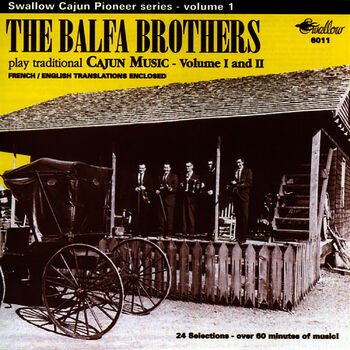
This month we have a guest feature from one of you, our wonderful Coop members! Our friend Patrick Stroudly suggested that it could be fun to follow the history of a particular Cajun song, and rose to the occasion when we suggested that he look into it for his favorite tune, ‘Tit Galop, made popular by the Balfa Brothers in 1967. But there’s more to the story than that …. take it about, Patrick!
What’s your favourite Cajun song? Perhaps trickier, what’s your favourite version of that song? Even within the confines of the culture, there’s likely to be more than one version you particularly like, isn’t there? I suggested to Joel that it might be a fruitful process to have someone write about a particular song, and trace it’s life from birth to now. I thought the author would need to be a Louisiana Man, or Lady. But Joel threw the challenge back at me, an ageing rocker from London, England. So I’m setting out on this road, aware that whilst I’m in the driver’s seat, many of the passengers know the road better than I do, but I promise you some fun along the way.
The first song I thought of was ‘’Tit Galop Pour Mamou”, the Balfa Brothers classic. I first heard it on DL Menard’s ‘No Matter Where You Are, There You At’ 1988 CD, unimaginatively retitled ‘Let’s Gallop To Mamou’ (see playlist) but worry not, all the lyrics are in French, and there’s a scorching accordion by Blackie Forester. This is, for me, classic, top-class Cajun. I’ve heard DL perform the song at JazzFest on several occasions in the 90s and the noughties, and also at his home in Erath, where he hosted visits from Nancy Covay’s Festival Tours during that same period. D L was a great musician, with a long and hugely successful career. Beyond that he was the warmest, most genuine person I’ve ever met.
As ever, when you hear a great cover, you want to go back to the original, which took me to the aforementioned Balfa Brothers song, first recorded in 1967 on their ‘Play Traditional Music’ LP (see playlist). This was the year when rock music was at its peak, with the likes of the Beatles ‘All You Need Is Love’, ‘Strawberry Fields Forever’ The Stones’ ‘Ruby Tuesday’, Van Morrison’s ‘Brown Eyed Girl’, and , closer to home, Aaron Neville’s ‘Tell It Like It Is’. ‘Tit Galop’ sits well with that elite crowd. Perhaps the best of the Balfa Brothers recordings? The recorded version drives along for barely 2 minutes, and then stops having accomplished everything it set out to do. It is perfectly recorded, all the acoustic instruments audible and combining into one rolling entity. Makes you want to jump back into a time machine, and find a Balfa Brothers gig when they stretch the song out, maybe even to 3 minutes!
Now, harmonica is a rare instrument in Cajun, isn’t it? And a female artist in the 1970s in the field is just as rare, I’d say. So combine the two and what do have? You have Elisabeth Landreneau, on the 1977 Cajun Home Music LP, a compilation featuring two other songs by Elisabeth (see playlist). Elisabeth was 73 at the time of the LP release, and it is more than likely the recording is from an earlier period. It’s good, and it's different. Youtube has a short video of Elisabeth from 2008 with a different version (above).
Jump to 1991, and ‘Tit Galop’ shows up on the soundtrack to the film “Scorchers” as a guitar led, rock song from a group called Mamou, led by Steve LaFleur who is from Mamou. It works really well, rocks along. Still available on Bandcamp, Mamou have their own CD, a mix of originals and cajun covers Just our sort of stuff!
Next up, in 2007, are the Anarchist Orchestra, with a punkish rendition, which works tolerably well (see playlist).
We’re now in the era of ‘unofficial’ recordings, without the artist being tied to a label. YouTube have a recording of Al Berard from 2012, which swings along nicely, a live show (right).
Yvette Landry, recently best known as the author of the Warren Storm biography ‘Taking the world By Storm’ appears with the Le Blanc Family Band on a ladies only version, again on YouTube from 2017 (below left)
And there’s a Canadian version too, from 2019 (below right). Including a great example of how you can dance really well without having to be over-flamboyant – that lady has rhythm! The band is Pays d’en Haut who are from Peterbrough County, in Ontario. The pace is maybe slower than most, still great to dance to.
One final comment. Cajun songs seem to extract more fun or drama from every day events that any other culture I know, this song is about selling a mule and a wagon for money to buy candles and sugar for the family. I hope you enjoyed this walk through the life story, so far, of one of cajun’s most loved songs. There’s plenty more where that came from…
—- Patrick Stroudley
We hope you enjoyed this edition of the Coop – we’ll see you next month
Have Feedback? Have ideas for a story you’d like us to cover, or a topic you’d like to learn more about? We’d LOVE to hear from you! Write us at bonjour@valcourrecords.com or using at the contact form at the bottom of this page and we’ll be more than happy to get back to you.

The Coop is produced through a partnership between Valcour Records and Atchafalaya National Heritage Area as well as with support from the Acadiana Center for the Arts ARTSpark Grant, and from the Arhoolie Foundation.